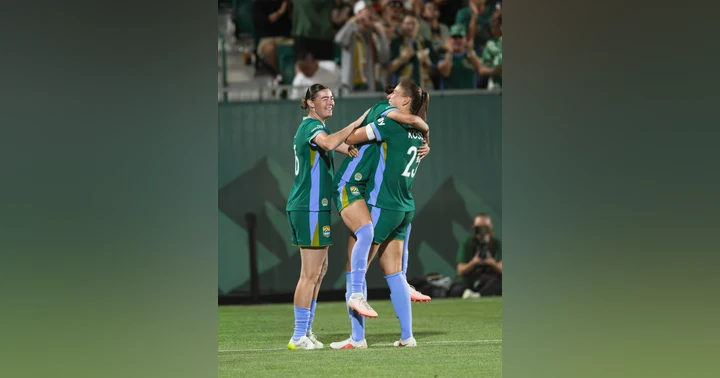
Before She Ever Played a Minute: Jasmine Aikey's Road to Denver
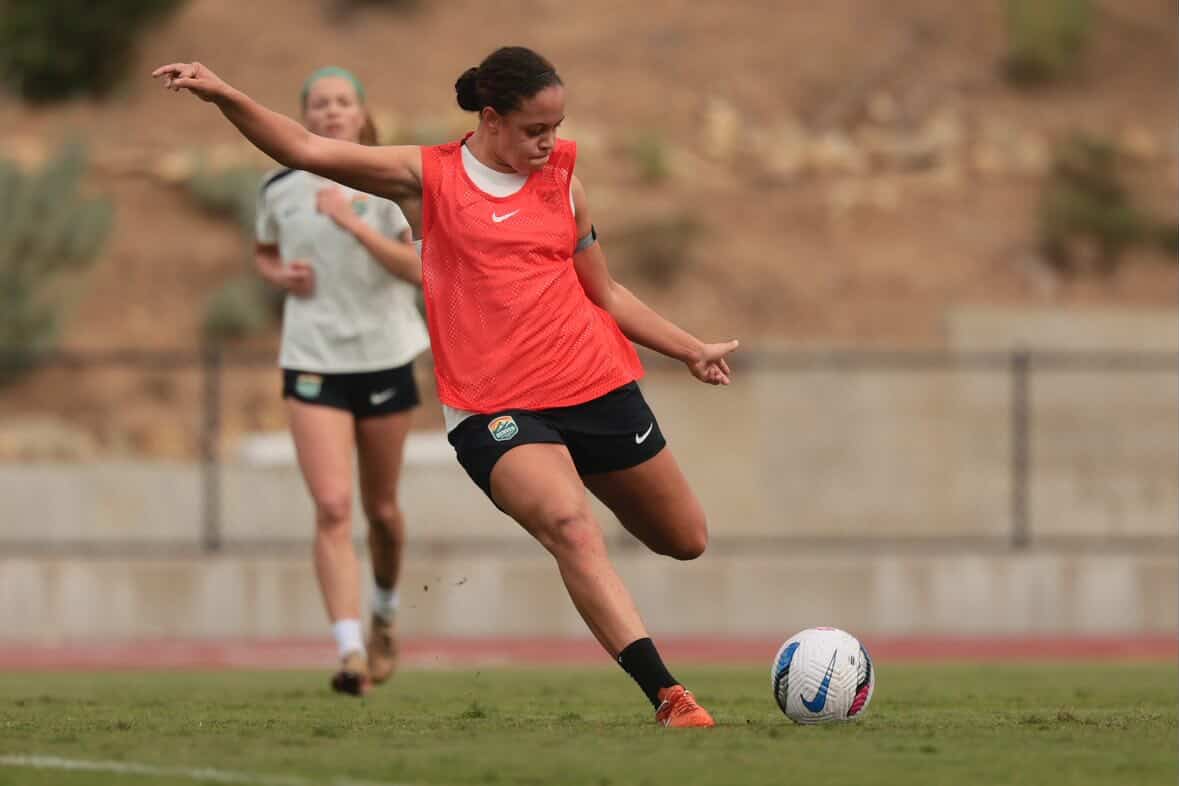
The Hermann Trophy winner signed her first pro contract in January. Six weeks later, her rookie season was over before it started.
Jasmine Aikey decided she was going to Stanford when she was seven years old.
Not because of soccer. Because someone told her it was the hardest school in the country to get into. And she thought — well, that's the one.
That detail tells you everything. This isn't a player who stumbled into greatness. This is someone who has been building toward something her entire life, on and off the field. And yet here she is, twenty years old, in Denver, on crutches, watching her teammates play games she was supposed to be in.
She sat down with me on the 5280 Pitch this week for her first interview since the injury. We talked for over thirty minutes — about Palo Alto, Stanford, four years of injuries that would have ended most careers, and what a Tuesday morning looks like when you're rebuilding your knee in a city where you're supposed to be making your professional debut.
It's a lot. And she handled all of it with a kind of calm that, honestly, I find remarkable.
How Soccer Almost Didn't Happen
Jasmine grew up in Palo Alto, California — minutes from Stanford's campus, which she'd been eyeing since second grade. Soccer, though? That almost didn't happen at all.
Her dad missed the first year of AYSO signups. She started with softball instead. By the time she got into soccer a year later, she was already doing taekwondo competitively. So for a while she was juggling three sports, trying to figure out which one was hers.
"I stopped softball at about around 10," she told me. "And I stopped taekwondo shortly after. Pretty much since I was 11 or 12, I've kind of specialized in soccer — which is a little early."
She knew soccer was it. Not because she was the most naturally gifted. By her own admission, she was probably a better softball player. But soccer was the one she wanted.
The taekwondo piece is interesting. I asked her if earning a black belt helped her learn how to strike a ball — seemed like a reasonable question — and she kind of smiled at that.
"It more so helped me with discipline and perspective," she said. "There's certain things you can't really teach until you go through it. And I think discipline is probably one of them."
That word — discipline — is going to come up a lot in Jasmine's story.
The Meniscus, the Knee, and Learning to Come Back
When she was twelve, she tore her meniscus. Her first serious injury. She described it as a minor injury in the grand scheme of things — three month recovery — but she was twelve. The world felt like it was ending.
What happened next matters. During rehab, she started weightlifting for the first time. And when she came back, she was more athletic than before the injury.
"That was the first kind of aha moment for me," she said. "Putting in the work physically will lead to better outcomes in the future."
She also had older players around her who had been through injuries. A support system. Parents who got her to good PTs. She kept her head above water. And she kept playing.
Around thirteen, she started homeschooling. Not because of academics — because of soccer. She'd gone to her first youth national team camp at twelve, and the school system wasn't going to accommodate the schedule. One PE teacher nearly failed her for missing class to represent her country.
"My parents were like, this isn't sustainable," she said. "Any given teacher can fail you and you can't do anything about it if you're not in class."
So her mom — now a board member of major companies, someone Jasmine describes as her biggest role model — retired to homeschool her. And Jasmine started taking community college classes as a high schooler, began accumulating credits, and never took her foot off the gas academically.
She also never stopped thinking about Stanford.
Four Years on the Farm
She got in. Of course she got in.
And then freshman year, she called her dad from preseason and told him she needed to redshirt.
"I was like, I need a redshirt. I'm not good enough. This is going terribly."
She didn't redshirt. By October, she had a hat trick against Oregon State. By November, she dropped four goals in a single NCAA tournament game against San Jose State — the first time a Stanford freshman had ever done that. She finished the year with ten goals, led the team in scoring, and earned second-team All-Pac-12 honors.
Then she had knee surgery.
Sophomore year she came back as a different player. Eleven goals, but she also led the Pac-12 with twelve assists. The Pac-12 Midfielder of the Year. First-team All-American. She wasn't just finishing anymore — she was running an offense. Stanford went to the College Cup final and lost to Florida State 5-1. Painful, especially for a team that had looked so dominant all year.
Then junior year happened. And this is the part of her story that doesn't get enough attention.
The Year Nobody Talks About
Junior year, Jasmine was moved to center back. Not her position. Not even close to her position. She spent years as a midfielder and forward, and suddenly she was anchoring a defense.
She did it because the team needed her to. Because that's who she is.
But while she was adjusting to an entirely new role, she was also battling something far more serious — osteitis pubis, a pelvic condition that is notoriously difficult to diagnose. Months of pain. Different doctors. Different theories. No timeline. No answers.
"Different trainers and doctors bounded around various diagnoses," she wrote about that period. "No timelines for recovery were shared. It felt like I was stuck."
She played through it. Because of course she did. Then, late in the season, she broke her fibula at Notre Dame. Surgery. Plate and screws. Season over.
She told me that fracture actually forced some real reflection. "I actually really didn't foresee myself playing in the NWSL until like the end of last year," she said.
She went into her senior year having never fully committed to going pro. That changed.
The Storybook Senior Year
Senior year, Jasmine Aikey was back at striker. And she was the best player in college soccer.
Twenty-one goals. Eleven assists. Fifty-three points — the most in the nation, by a wide margin. ACC Championship. ACC Tournament MVP. Stanford's third straight College Cup appearance. The Hermann Trophy, college soccer's equivalent of the Heisman. And the Academic All-America Team Member of the Year — with a 3.97 GPA in computer science.
Only one player in history has won both the Hermann Trophy and the Academic All-America Team Member of the Year in the same season. Christine Sinclair, in 2005. Jasmine Aikey is the second.
When I asked her how she balanced all of it — the degree, the training, the travel, the pressure of being the best player in the country — she didn't pretend it was easy.
"Truthfully, a lot of tears," she said. "I think my dad can tell you that. There was a lot of crying."
She paused, then added: "I'm really content with the path I chose. And even though it was a lot of work, I'm really happy with how it worked out."
That's the thing about Jasmine. She doesn't perform gratitude. She actually has it. You can hear the difference.
Why Denver
Denver Summit FC announced the signing of Jasmine Aikey on January 8th, 2026. Two-year deal, mutual option for a third. And when I asked her why she chose an expansion team — a club with no history, no culture, no guarantee of anything — her answer was immediate.
"When I had my first calls with Curt and Nick and all the other amazing people who hopped on a call with me, it was very clear that the club had a direction."
She also had history with Colorado. She lived here during COVID when her team's training was shut down. She committed to Stanford at a showcase in Colorado. Her best friend is at the Air Force Academy. This place wasn't foreign to her.
And she knew the fans would show up. The 15,000 season ticket deposits, the home opener excitement — she believed in it before most people did.
"To be a part of something and build it up from the ground up was very exciting," she said. "As someone who has played soccer in Colorado when I was younger, I knew that there'd be fans."
She was right. Sixty-three thousand of them showed up on March 28th.
Before a Single Minute
March 23rd. Five days before the home opener. Denver Summit FC announced that Jasmine Aikey had torn the ACL in her right knee at a U.S. Under-23 national team camp. Season-ending injury list. Done before she'd played a minute.
I asked her what those first few days were like. She was quiet for a second.
"Just a lot of disappointment," she said. "You work so hard for certain things and you're kind of just like — oh, I didn't even get a chance to play a game yet."
But then she pivoted. Because that's what she does.
"At the same time, there was a lot of gratitude. I was with my family. They were able to come fly out. And then I had to think about all the blessings I had already been given — to make it through my senior year uninjured and have that ending, to sign my first pro contract, to be in such a great place."
Four days after surgery, she went to the home opener anyway. Still on pain meds. Her dad drove her. She made it out onto the field for warmup, looked up at sixty-three thousand fans filling Empower Field at Mile High, and thought she was hallucinating.
"I was sure I didn't see Malala on the field," she said. "But I got a picture with her that proves that it was real."
Their box was shaking from the crowd noise. She signed jerseys after the game. She watched her teammates — the team she was supposed to be playing for — get their moment.
And she found a way to be present for it anyway.
What a Tuesday Looks Like Now
Rehab. Every day.
Her dad is staying with her in Denver because she can't drive. He brings her breakfast. She does upper body conditioning first, then PT for her knee, then goes home for lunch. Then she's back to it. She's watching film with the analytics staff over Zoom. She's sitting in on team meetings when she can get around. She went to watch a scrimmage last week.
"I feel like I'm so focused on the PT I'm doing that I'm not really thinking — oh, I'm missing out on this," she said. "I think that's something you have to get out of when you're going through an injury that's so long term. You can't really think about all the things you're missing because it's a lot."
She said she'll probably post a day-in-the-life video on Instagram soon. Which — honestly, I hope she does. Because this version of Jasmine Aikey, the one grinding through rehab at 5,280 feet while her teammates play NWSL games — this is part of the story too.
What Denver Is Getting
She described her game as creative. Flair. Different types of shots, different skills. Aggressive. Hard-working.
"Hopefully just like aggressive hard work," she said. "That's the identity of our team."
She's already watching the games with two eyes — one as a fan, one as a teammate who knows everything that's happening inside the building. She's talked about the defensive group, how locked in they've been. She called Melissa Kössler "our German robot up there scoring goals."
She sees this team clearly. She believes in it. And she cannot wait to be part of it — on the field — in 2027.
Nick Cushing said publicly that Jasmine means so much to this team both on and off the field. After spending thirty minutes with her, I understand exactly what he means. The talent is obvious. The résumé speaks for itself. But it's the other stuff — the discipline, the perspective, the way she finds gratitude in genuinely hard moments — that's going to make her something special in Denver.
This team is building something. And so is she.
Let's go Summit.
Listen to the full Jasmine Aikey episode of the 5280 Pitch on Spotify and Apple Podcasts. New episodes every week. Follow us @5280pitch.
Host of The 5280 Pitch | Former 850 KOA Broadcaster | Colorado Native
Kate Hanson is a veteran sports broadcaster and the voice behind The 5280 Pitch, Denver's home for Summit FC and NWSL coverage. With years of experience at 850 KOA—Denver's premier sports radio station—Kate brings professional broadcasting chops and deep Colorado sports knowledge to women's soccer coverage.
As a Colorado native and lifelong soccer fan, Kate covers Denver Summit FC's inaugural season with the same depth and analysis she brought to Denver's other professional teams. Her style is direct, energetic, and unapologetically passionate about treating women's soccer with the respect it deserves.
What Kate Talks About:
-Denver Summit FC's expansion season and NWSL growth
-Tactical breakdowns, player profiles, and match analysis
-The altitude advantage and what makes Centennial Stadium unique
-Building community around women's professional sports in Denver
-Colorado soccer culture and the youth development pipeline
-Women's sports media and broadcast coverage
Kate's broadcast background at 850 KOA gives her a unique perspective on how women's soccer fits into Denver's sports landscape—and why this moment matters for the city and the league.
Available for:
-Podcast guest appearances
-Panel discussions on women's sports media and broadcasting
-Denver sports commentary and NWSL analysis
-Soccer culture and community-building conversations
Contact: 5280pitch@gmail.com
When she's not behind the mic, Kate is usually at a pitc…
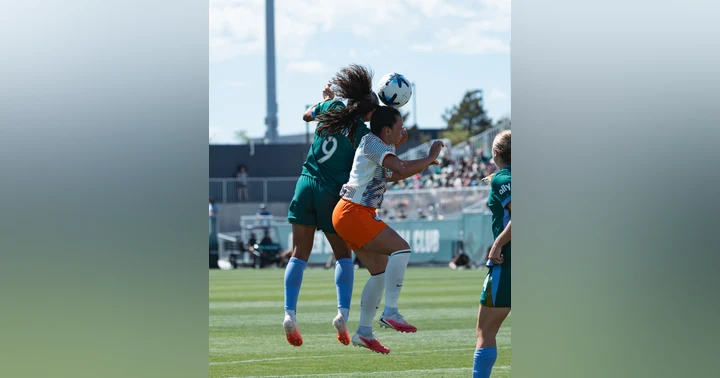
Denver Summit FC 3-0 Gotham FC: The League's Best Defense Falls Twice, and the Playoff Math Gets Tighter