
Carson Pickett: Why Denver's Expansion Team Was the Right Move
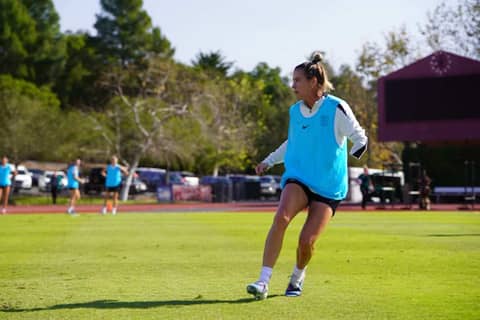
From $8,000 salaries to 45,000 fans. The veteran left back on what's changed in the NWSL—and why she's building something from scratch in Denver.
Carson Pickett has been in the NWSL since 2016. She's played 185 games across six different clubs. She's seen the league go from host families and one physio per team to full stadiums and national TV deals. And when free agency opened this offseason, she had options. Established teams. Playoff contenders. Places where the infrastructure was already built.
She chose Denver.
An expansion team. No history. No home stadium ready yet. Just a vision and a roster being assembled from scratch.
When I asked her why, her answer was immediate: she was ready to give back to the league that had given her everything.
The Decision to Build Something New
Free agency in professional sports is strategic. You evaluate fit, coaching staff, roster composition, championship potential. But for Carson, this decision carried different weight.
She's 31 years old. She's won championships with North Carolina Courage. She's made two NWSL Best XI teams. She's played 90 minutes for the United States Women's National Team. At this stage of her career, she could have chosen stability. She could have chosen a team already positioned to compete for trophies.
Instead, she chose uncertainty.
"I felt like I was in a position in my career to go somewhere to help build something instead of just step into a team that is top four," Carson told me. "I felt like it was time for me to give back to soccer and to the NWSL and just go be a leader and start a brand new club from the ground up."
That's not rhetoric. That's someone who understands what it means to be a veteran in a league that desperately needs veterans willing to anchor expansion teams. Denver needed experience. They needed someone who had seen the league evolve, who knew how to manage a locker room, who could help younger players navigate their first professional seasons.
Carson also had history here. She played in Denver during college, spending a summer with Rush Denver as part of a team-mandated summer league experience at Florida State. She played alongside Janine Sonis back then—11 years ago. Now they're teammates again, reunited in the city where they first played together.
That connection mattered. So did the city itself.
"I have never been to a place that loves sports more than Denver," she said. "The fact that you have pretty much every men's sports team represented here—this place is soccer obsessed."
She came to Denver over Christmas to look for apartments. Within two days, three different people stopped her on the street to welcome her to the team. Not because she was wearing Summit gear. Just because they recognized her and knew she had signed.
That doesn't happen in most NWSL cities. Not yet.
What It Was Like in 2016
When Carson entered the league as the fourth overall pick in the 2016 draft, the NWSL was still figuring out if it would survive. She was making $8,000 for six months of work. The next year, her "big raise" brought her to $16,000.
You can't live on that. Not without help.
"I owe it all to my parents because I truly would not be able to play," she said. "Girls were coaching. They were getting jobs as baristas. They were working in restaurants. People were having to have two different jobs."
In Seattle, where she was drafted, the team practiced in a public stadium. They had to move their equipment every day because a high school football team used the same field. They had one physio for 22 players. They got one set of gear for the entire season—no hoodies for travel, no extra training kits. Nothing.
Carson had just come from Florida State, where she was getting hundreds of pieces of gear as an ACC athlete. Then she stepped into the professional league and got one kit.
"It's no fault to theirs," she clarified. "It was just how the league was. We were trying to just survive and get to play the game we love."
That survival mentality defined the early NWSL. Players stayed in host families. Rosters were thin. Resources were minimal. But the league survived. And then it started to grow.
Now, nearly a decade later, Carson sees the difference everywhere.
"I finally feel like my profession isn't a joke," she said. "When I say I play professional soccer, people now are like, 'Oh, in the NWSL.' They know there's a league. They finally understand that it is a real league."
The CBA protects players now. You can't be traded without consent. Salaries are livable. Teams have full medical staffs. The infrastructure exists.
And yes, Carson acknowledges she missed out on money. The players coming into the league now are making significantly more than she did at their age. But she doesn't regret it.
"I'll forgo money for the experience of just seeing this league grow tremendously," she said. "In my position, I think it is so cool to have seen the start to where we are now and to actually be a part of it."
The North Carolina Years
Carson's career trajectory changed when she joined North Carolina Courage. That's where she became one of the best attacking outside backs in the league. In 2022, she led the entire NWSL in assists—six—as a left back. That number doesn't make sense unless you understand how North Carolina played.
"The style of play and the players I was around were the biggest difference," she explained. "In a lot of teams before that, I was a defender. I was only a defender. It wasn't like I was an attacking defender."
North Carolina changed that. Paul Riley wanted his outside backs high and involved in the attack. Carson finally had the freedom to play the way she naturally played—pushing forward, creating chances, trusting her teammates to cover behind her.
"I started to play the game that is more my type of game, which is an attack-minded outside back," she said. "I just trusted my teammates so much that if we lost the ball, they were gonna get back for me."
She was named to the NWSL Best XI in 2021 and 2022. She became one of the most consistent performers in the league. And in June 2022, she made her debut for the United States Women's National Team against Colombia, playing all 90 minutes in a 2-0 win.
That debut carried extra weight. Carson became the first player with a limb difference to represent the USWNT. When she walked out of the tunnel for warmups, hearing the "USA" chants, she wasn't just representing her country. She was representing an entire community.
"I felt so much pride for also representing limb difference," she said. "No one has ever been on the national team with a limb difference. I was the first one. So that was heavy in a way, because I just felt like I was representing so many people."
She saw her parents in the stands. Her dad had been her coach growing up. Seeing them wearing her jersey in that moment—she said she could have cried if she wasn't so nervous.
Building an Expansion Team
Expansion teams in professional sports face a specific challenge: they need veterans to provide stability, but they also need young players ready to contribute immediately. The balance is delicate. Too many veterans and the roster becomes expensive and aging. Too many rookies and the team lacks experience when games get tight.
Denver's roster reflects that balance. Carson is joined by veterans like Kaleigh Kurtz, Janine Sonis, and Abby Smith—players who have been in the league for years and understand what it takes to compete. But the roster also includes rookies like Olivia Thomas and Natalie Means, who have already shown they can contribute at this level.
"I feel so incredibly blessed that we have great grandmas," Carson said, referencing the group chat she shares with the veteran players. "We do call ourselves the grandmas. We have a group chat and it is called the Denver Summit grandmas."
That veteran leadership matters, especially in year one. Expansion teams don't have the luxury of gradual development. The rookies need to contribute now, not three months from now. And Carson is confident they will.
"They hop on board to everything that we asked them to hop on board on," she said. "They are so receptive, they're open to learning, there's no attitude that comes with it. They truly do want the best for the team."
The locker room culture is being built in real time. There's no established way of doing things because there's no history to lean on. That's both a challenge and an opportunity. However this team starts—whatever culture they establish in these first months—will define the club for years.
Carson understands that responsibility. She's been part of championship teams. She knows what good locker rooms feel like. And she's bringing that experience to Denver.
The Altitude Factor
Training at 5,280 feet is not subtle. Carson, coming from Florida—essentially sea level—felt it immediately.
"It's been awful," she said, laughing. "I'm not even gonna sugar coat it. Coming from Florida especially, it was awful at first."
She climbs 14 stairs to get breakfast every day. She's out of breath every single time.
But that discomfort is strategic. If it's hard for Denver's players—who train here every day—it's going to be harder for visiting teams who fly in the day before a match.
"Nick calls it our third lung," Carson said. "I truly think it is. Once we get past that 60 minutes where most people get extremely tired, especially in this league, I think it will just help us so much."
The altitude advantage works both ways. When Denver travels to sea level, their players will have an edge in endurance. They'll be able to run longer, recover faster, sustain pressure deeper into games.
"I actually think it's both," Carson said. "Teams will definitely struggle here, but I also think we will be able to capitalize when we go to sea level as well."
March 28th
Denver has already sold over 45,000 tickets for the home opener against Washington Spirit on March 28th. That will break the NWSL attendance record before the team has played a single home game.
Carson has played in big stadiums before. She's played in front of large crowds. But this feels different.
"Denver has already showed up," she said. "Without even stepping on the field, without having a game, I truly believe they're the best fans in this league."
That support comes with pressure. The city is invested. The fans are showing up. Now the team has to deliver a product worth watching.
"We want to play a style that is fun to watch and that people are proud of," Carson said. "When we're on the TV, they're like, that's my team."
She's confident the team will rise to the moment. The roster is talented. The coaching staff has NWSL experience. The infrastructure—despite being brand new—has been built thoughtfully.
"I have been so incredibly impressed with how this club has been run from the ground up within the last six to eight weeks," she said.
There will be bumps. Expansion teams always have them. But the foundation is there. The culture is being built. And on March 28th, in front of 45,000 fans, Denver Summit FC will step onto the field for the first time.
Carson Pickett will be there. Leading. Building. Giving back to the league that made her career possible.
And that's exactly why she's here.

Host of The 5280 Pitch | Former 850 KOA Broadcaster | Colorado Native
Kate Hanson is a veteran sports broadcaster and the voice behind The 5280 Pitch, Denver's home for Summit FC and NWSL coverage. With years of experience at 850 KOA—Denver's premier sports radio station—Kate brings professional broadcasting chops and deep Colorado sports knowledge to women's soccer coverage.
As a Colorado native and lifelong soccer fan, Kate covers Denver Summit FC's inaugural season with the same depth and analysis she brought to Denver's other professional teams. Her style is direct, energetic, and unapologetically passionate about treating women's soccer with the respect it deserves.
What Kate Talks About:
-Denver Summit FC's expansion season and NWSL growth
-Tactical breakdowns, player profiles, and match analysis
-The altitude advantage and what makes Centennial Stadium unique
-Building community around women's professional sports in Denver
-Colorado soccer culture and the youth development pipeline
-Women's sports media and broadcast coverage
Kate's broadcast background at 850 KOA gives her a unique perspective on how women's soccer fits into Denver's sports landscape—and why this moment matters for the city and the league.
Available for:
-Podcast guest appearances
-Panel discussions on women's sports media and broadcasting
-Denver sports commentary and NWSL analysis
-Soccer culture and community-building conversations
Contact: 5280pitch@gmail.com
When she's not behind the mic, Kate is usually at a pitc…
