"A cathedral built for her potential": Denver Summit FC breaks ground on Santa Fe Yards
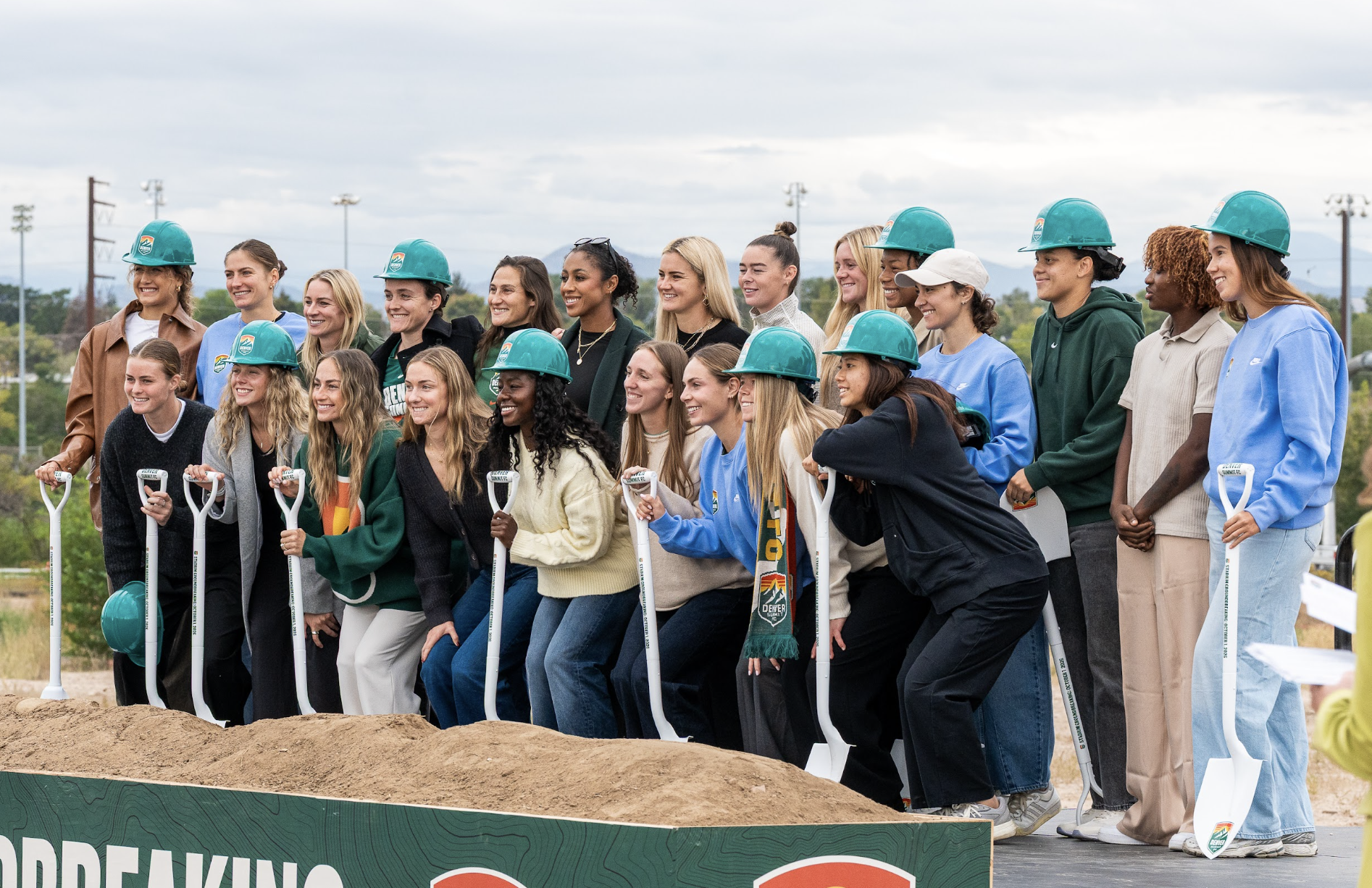
Photo Courtesy @victorgraphy_20
For years, the land off I-25 and Broadway held the old Gates Rubber factory, a giant abandoned building with broken windows that anyone driving through Denver couldn't miss. Then the building came down, and for a long time it was just an empty lot.
On Thursday, Oct. 1, Denver Summit FC put shovels in it.
Santa Fe Yards will be the club's permanent home: 12,500 fixed seats, with safe-standing areas taking capacity to about 13,000. It will have plenty of shade, which fans at Centennial Stadium have asked for more than once. The club is targeting completion by the end of 2028, so the Summit will play most of their 2028 home schedule at Centennial before moving in. It will be only the second stadium in the country built for a women's professional soccer team. The Kansas City Current opened the first in 2024.
Club president Jen Millet, a Cherry Creek High School graduate, closed the first speech of the morning with it.
"As women and girls, we are taught implicitly and sometimes explicitly not to take up too much space," she said. "Women's sports have never lacked talent. For decades, the energy, passion and economic power of this game have been bursting at the seams of borrowed venues, borrowed dates, borrowed locker rooms under somebody else's lights."
Then she got to the site itself. "We aren't building on the outskirts. We aren't building in the margins," Millet said. "And when a young girl walks through downtown Denver, looks up at these gates and steps inside, she won't see borrowed space. She will see a cathedral built for her potential. She will learn, without anyone having to say a word, that she is allowed to stand tall, make noise and take up all the space in the world."
"A field of her own"
Mayor Mike Johnston spoke next and picked up Millet's theme. Millet had quoted Virginia Woolf's line that a woman must have money and a room of her own. Johnston changed one word.
"This really is a field of her own, designed by women's sports for women's sports," he said. "That was what was missing in this landscape for so long."
Then he worked in nearly every pro team in town, getting on "that trusty Bronco," crossing the Rapids, the Rockies, the Mammoth, the Nuggets, before landing "at the summit, and that is where we are."
He also brought a shirt. It was printed the day the franchise was announced, and it just said Denver NWSL. "Didn't have a name, didn't have a logo, but we had a dream," Johnston said. "It was 10-year-old girls on the way to games in this city. It was fans in bars who mobilized around the idea of a women's sports franchise."
He admitted to one more dream. In his first sports-radio interview after the announcement, he said, he'd hoped the club might bring Lindsey Heaps home. "And now I'm most proud of all to put on my Lindsey Heaps jersey."
The money behind the moment didn't come easily. The city put $50 million toward the stadium and another $20 million toward everything around it: roads, a park and a pedestrian bridge to the light rail station. The ownership group is paying for the stadium itself, expected to cost around $200 million. Getting the city money approved meant a long and at times messy fight at City Council last December.
Controlling owner Rob Cohen thanked the people who sat through it. "If you're a business from South Broadway, you showed up and you testified at city council," he said. "Some of you, and you know who you are, took your daughter out of school and brought them down to city council meetings, long city council meetings, so that she could sit there and say, I was there when this dream started."
He said there were tough nights and tears along the way. What kept them going, he said, was the chance to design a stadium with the athletes, the supporters and the community in mind. "This is a demonstration to the world about how to invest in women and how to invest in professional women's sports," Cohen said. "My dream one day is that a young player will walk into a stadium built by a football club in Denver that's been part of the fabric of this community for a long time, and it will no longer be a novelty. It will be normal."
"This neighborhood has really been cut off"
The person running the build every day is from here, too.
Elizabeth Erling is Mortenson's project executive on Santa Fe Yards. She grew up in Colorado playing soccer, and her daughter plays now. She remembers the empty lot. After the ceremony, she told The 5280 Pitch what she sees in it.
"First of all, this neighborhood has really been cut off," Erling said. "Seeing this really bring those two neighborhoods together is going to be really exciting. I also think just walking into this place is going to feel a lot different with the park that's here, the city of Denver park that's going to lead up to the stadium. It's a very different facility than what we have right now."
She also explained why a drive past the site won't show much yet. Thursday was about starting utility work and getting the site ready. Vertical construction, the part people will actually see go up, starts in earnest next summer.
Populous designed the stadium. It's the same firm behind the club's CommonSpirit Performance Center and the Buffalo Bills' new stadium. Mortenson is building it with Gratacon, a woman-owned general contractor out of Lakewood led by CEO Jessica Ostitch.
Women made up about 11% of the U.S. construction workforce last year, and that was a 20-year high. In the hands-on trades, the share is closer to 4%.
The club's community benefits agreement, negotiated with West East Neighborhoods United, adds more of the same. Summit FC committed to reaching out to women- and minority-owned businesses for construction, with a goal of hiring at least 25 of them. At least a quarter of the stadium's food and drink vendors must be women- or minority-owned. Millet called it the first community benefits agreement in women's professional sports.
The ceremony stayed local, too. Mariachi played as people arrived. The food and coffee came from businesses in the neighborhood, and the gift bags on the seats were filled from local, women-owned shops. Shannon Francis, who is Diné and Hopi, opened with a land blessing, burning sage and cedar and speaking about the South Platte River, which runs beside the site.
"Water holds memory, water is alive, and we want to honor that," Francis said. "Always honor and protect our waters."
"Do you need a center back?"
Thursday was the players' day off. Nearly the whole roster came anyway.
"This is the day they're supposed to sleep in and get rest," Cohen said from the stage. "But they chose to be here."
The three captains, Kaleigh Kurtz, Janine Sonis and Lindsey Heaps, put on hard hats and picked up shovels alongside Rob and Molly Cohen, Johnston and District 7 Councilwoman Flor Alvidrez, whose district includes the site. The emcee asked the crowd to get loud for "the first permanent stadium for women's professional soccer in Colorado," then counted to three.
Sonis grew up in Highlands Ranch and has been driving past the site on I-25 for years. "The level of investment is something that in my whole career I've never seen," she said during an on-stage conversation hosted by Jordan Angeli. "To have a temporary stadium that's nicer than most other stadiums that we play in is a pretty big deal. And then to have driven past this site for a long, long time on I-25 and think, what is that? And now people are going to drive by here and see a world-class stadium where world-class female athletes get to perform."
Eva Gaetino grew up in Michigan and played at Notre Dame and for Paris Saint-Germain. The NWSL she remembers from childhood looked nothing like this.
"I knew there was the NWSL, but you would look in the stands and there would be no fans there. No one would be there. They'd be on turf," she said. "And to see young girls, older generations, whoever, just feeling a part of something, and seeing how much people believe in women and women's sports, I just really hope we can hold on to that, because I know it won't be a straight line to success. I know there will be setbacks, but we're all unified in this."
She put it more simply earlier on stage. "For so long, women have been in borrowed spaces and on borrowed time," Gaetino said.
Heaps, from Golden, came up through Colorado Rush. Growing up, there was no professional women's team here to look up to. She watched Messi and European football instead. "If I look back now and I was able to walk into a stadium when I was 9, 10 years old and see a professional women's soccer team playing here, man, would that be inspirational," she said. She has noticed the boys in the stands at Centennial, too.
Millet said building the club this way is also how it recruits. This is the first NWSL year of full free agency, with no draft, and that's daunting for an expansion team. "Players from Colorado already know how special Colorado is," she said. The training facility, Centennial Stadium and now Santa Fe Yards are all part of the pitch.
Heaps says it's working.
"I've heard from so many players across the league, do you need a center back? Do you need a— like, people want to be here," she said. "People see our facility and people see what we're doing here today. I can't say enough good things. I can't say a bad thing. That's really exciting for NWSL, because now we are looked at as one of the best club environments, and we've been here for less than a year."
Host of The 5280 Pitch | Former 850 KOA Broadcaster | Colorado Native
Kate Hanson is a former 850 KOA broadcaster and the voice behind The 5280 Pitch, Denver's home for Summit FC and NWSL coverage. With her time at 850 KOA—Denver's premier sports radio station—Kate brings professional broadcasting chops and deep Colorado sports knowledge to women's soccer coverage.
As a Colorado native and lifelong soccer fan, Kate covers Denver Summit FC with the same depth and analysis she brought to Denver's other professional teams. Her style is direct, energetic, and unapologetically passionate about treating women's soccer with the respect it deserves.
What Kate Talks About:
-Denver Summit FC's expansion season and NWSL growth
-Tactical breakdowns, player profiles, and match analysis
-The altitude advantage and what makes Centennial Stadium unique
-Building community around women's professional sports in Denver
-Colorado soccer culture and the youth development pipeline
-Women's sports media and broadcast coverage
Kate's broadcast background at 850 KOA gives her a unique perspective on how women's soccer fits into Denver's sports landscape—and why this moment matters for the city and the league.
Available for:
-Podcast guest appearances
-Panel discussions on women's sports media and broadcasting
-Denver sports commentary and NWSL analysis
-Soccer culture and community-building conversations
Contact: 5280pitch@gmail.com
When she's not behind the mic, Kate is usually at a pitch somewhere in Colorado, cheering o…
Denver Summit Report Card: Nick Cushing on Year One in Denver